
How Clear Records Support Stronger Cases
Clear records help a legal claim move from uncertainty to a more organised, evidence-led process.
For claimant solicitors, medical records are not just background documents. They help identify the injury, understand the treatment history, guide expert selection, support report preparation, and reduce avoidable delays. When the records are incomplete, unclear, or difficult to follow, the whole medico-legal process can become slower and less efficient.
This is why preparing medical records for legal claims should be treated as an important early step, not a final admin task.
Why medical records matter in legal claims
Medical records help provide context for the expert. They may show the claimant’s medical history, treatment timeline, symptoms, investigations, referrals, medication, and any previous relevant conditions.
For a medical expert, these records can help them understand the case more fully before preparing their independent opinion. For a solicitor, they help clarify what type of expert may be needed and whether further information should be gathered before an instruction is progressed.
A well-prepared file can support smoother communication between solicitors, experts, and administrative coordinators. It also helps avoid repeated questions that could have been answered at the start.
Clear records support better expert selection
Before an expert is instructed, the case needs to be understood properly. The medical issue, injury type, location, urgency, and available documentation all affect which expert may be suitable.
For example, a claimant with persistent spinal symptoms may need a different expert route from someone with psychological symptoms, upper limb injury, chronic pain, neurological concerns, or multiple ongoing complaints.
When the records are clear, it becomes easier to assess whether the case may need an orthopaedic consultant, neurologist, psychologist, psychiatrist, pain management specialist, physiotherapist, or another independent medical expert.
This does not mean the records decide the medical opinion. The expert remains responsible for their own independent conclusions. However, organised records can help the instruction reach the right type of expert from the beginning.
What a strong case file should include
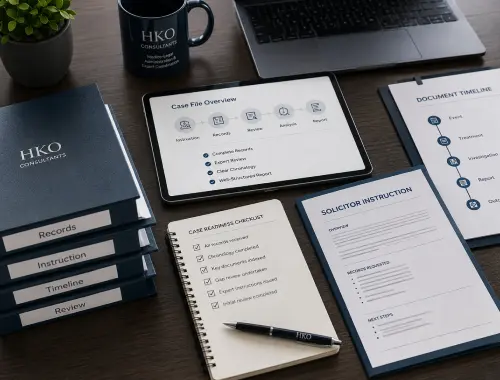
A useful legal case file should give the expert and coordination team enough information to understand the instruction without unnecessary confusion.
It may include:
- The claimant’s basic case details
- The main injury or medical issue
- Relevant medical records
- Details of previous treatment
- Diagnostic information, if available
- The solicitor instruction letter
- Any previous medical reports
- Important deadlines or court-related dates
- The claimant’s location
- Any special appointment considerations
- Clear questions for the expert, where appropriate
The purpose is not to overload the expert with irrelevant material. The purpose is to provide the right information in a structured way so the case can be reviewed properly.
The instruction letter is important
A solicitor instruction letter should clearly explain what is being asked of the expert. It should identify the case background, the issues to be considered, and any specific questions that need to be addressed.
A vague instruction can create delays because the expert or administrative team may need clarification before the work can progress. A clear instruction helps everyone understand the scope from the start.
The instruction letter also helps protect the separation of roles. The solicitor provides the legal instruction. The expert provides the independent medical opinion. The administrative team coordinates the process, documents, appointments, communication, and report flow.
This distinction is important in medico-legal work.
Complete records can reduce avoidable delays
Many delays in medico-legal coordination happen because key documents are missing, incomplete, or unclear.
A case may be held up because records have not been provided, the claimant’s location is missing, the injury details are too broad, or the urgency has not been declared at the start. Sometimes a matter appears ready to progress, but the expert cannot properly review it because important medical information is still outstanding.
Preparing the records early can help reduce these issues. It allows the case to be reviewed more efficiently, the right specialist to be considered, and the appointment or report process to move forward with fewer interruptions.
File readiness is especially important for urgent matters
When a solicitor has a time-sensitive case, file readiness becomes even more important.
Urgency should be made clear at the enquiry stage. However, even urgent matters still depend on expert availability, complete documentation, and the practical requirements of the case. A deadline alone does not make a file ready.
A strong urgent enquiry should include the case type, medical issue, claimant location, relevant records, deadline, and any instruction letter available. This gives the coordination team a better chance of reviewing the matter efficiently and checking what may be possible.
The clearer the information, the easier it is to assess the next step.
Records also support report-flow administration
Once an expert is instructed, the administrative work continues. Records may need to be checked, exchanged, organised, and followed up. Appointments may need to be arranged or rescheduled. Reports may need to be monitored through the administrative process.
This does not mean an administrative partner changes the expert’s medical opinion. The expert’s findings and conclusions remain their own. However, administrative checks can help ensure that the right documents have been received, formatting is complete, deadlines are monitored, and communication is handled professionally.
For solicitors, this can reduce unnecessary pressure on internal teams. For doctors, it helps ensure their medico-legal work is supported by a more organised workflow.
How organised documentation helps solicitors
For solicitors, well-prepared records can make the case easier to manage.
They help identify what expert input may be needed, what questions should be asked, whether further documents are required, and whether the case can progress to appointment or report stage. They also make communication with the expert or coordination team more efficient.
Good preparation can also improve client service. When the solicitor has a clear view of the case file, they are better placed to understand what is ready, what is missing, and what needs attention before the next step.
How HKO supports clear coordination
HKO Consultants supports solicitors and doctors with medico-legal administration, expert coordination, document handling, appointment flow, and report-flow management.
For claimant solicitors, HKO can help review enquiry details, coordinate with suitable independent experts, manage administrative communication, arrange appointments, and support the report process within the scope of the instruction.
For doctors, HKO provides medical-secretary-style administrative support around clinics, diaries, correspondence, documentation, and medico-legal workflow.
HKO does not provide legal advice, medical advice, diagnosis, treatment opinion, or expert conclusions. The independent medical expert remains responsible for the medical opinion. HKO’s role is to make the process clearer, more organised, and professionally managed.
Clear records create a stronger starting point
Medical records for legal claims are not just paperwork. They are the foundation for proper review, suitable expert selection, efficient coordination, and clearer case progression.
A complete and organised file helps solicitors avoid avoidable delays, helps experts understand the case context, and helps administrative teams coordinate the matter more effectively.
For support with medico-legal coordination, expert matching, appointment administration, or report-flow management, HKO Consultants can assist solicitors and doctors across the UK with a structured and professional approach.